Brigitta
The Ballad of the Last DragonBrigitta is Kingsley’s wife and the largely unseen provider behind Sylvaine’s first durable refuge in Hollowden. Though she is rarely placed at the center of the action, her food, labor, foresight, and affectionate partnership make The Rusty Nail more than a workplace: it becomes the closest thing Sylvaine has to a family home. Brigitta’s importance lies in the material form her kindness takes. She does not merely welcome an outsider; she repeatedly makes survival possible for an impoverished elf whose ears expose her to suspicion and hostility.
Identity and Place in Sylvaine’s Life
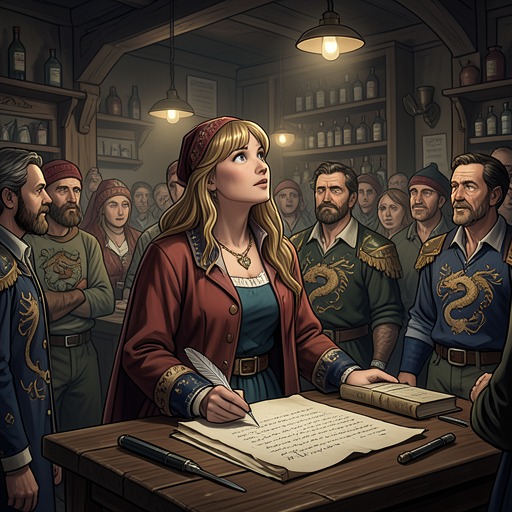
Brigitta manages The Rusty Nail with Kingsley and is one of the few people in Hollowden who never balks at Sylvaine’s pointed ears. Sylvaine describes the couple as unusually accepting in a town where keeping her ears covered helps prevent harassment. Kingsley may be the more visible presence behind the bar, but Brigitta’s care is woven through the tavern’s daily life: she notices what Sylvaine lacks, supplies it without humiliating her, and helps make room for her within the household’s limited resources.
That welcome matters because Sylvaine arrives at The Rusty Nail after fleeing Birchfield in desperate circumstances. The owner of the Red Wyvern Tavern had tried to exploit her hunger by proposing sex in exchange for food after finding her scraping half-eaten scraps from dirty plates. She reached Hollowden with little more than her lute, a few coins, and a cap pulled over her ears. Kingsley allowed her to sing, while Brigitta asked her to sample dishes for the tavern’s Winter Solstice celebration. Sylvaine later recognizes that the invitation was not casual hospitality but the couple’s first deliberate effort to protect her.
Brigitta’s kindness is therefore practical rather than ornamental. She and Kingsley are not wealthy, and their attempts to include Sylvaine place pressure on their purse, yet Brigitta still contrives to make extra food for her. Because The Rusty Nail has no kitchen from which Sylvaine can discreetly take plates, the help cannot be reduced to convenient leftovers; Brigitta has to plan for it and make it appear accidental. Sylvaine knows she is accepting charity, but the manner of that charity preserves her dignity enough for her to remain.
Care Expressed Through Food and Objects
Brigitta’s most revealing act of care comes when Sylvaine leaves the tavern to join Aeron Fowler’s expedition. Kingsley gives her a leather satchel containing enough salted jerky, apples, and carrots to feed her for a week, together with a pouch of her favorite mushrooms, witch’s butter and king bolete. Sylvaine immediately understands that Brigitta must have foraged and raided the household’s larder to stock the bag so generously. The provisions transform an emotional farewell into concrete protection for the road.
Brigitta’s influence also survives in the soap Kingsley gives Sylvaine. Its scent of black currant recalls his mixture of beech ashes and goat fat, enriched with black currant and mulberries. The parcel is presented as a simple comfort, but it carries the domestic world Brigitta helped sustain: nourishment, cleanliness, familiar scents, and the assurance that someone has anticipated Sylvaine’s bodily needs. Later, when Sylvaine washes while traveling, the black-currant scent brings tears to her eyes. The object thus becomes a portable fragment of The Rusty Nail, capable of making absence physically present.
Brigitta’s care extends beyond food and soap to clothing and craft. Sylvaine wears an emerald-green tabard embroidered with sunflowers that Brigitta added for her. The garment gives visible form to a relationship that might otherwise remain private. In a life where Sylvaine’s ears are treated as a public mark of otherness, Brigitta’s handiwork helps present her as someone dressed, recognized, and claimed by a community. The tabard also accompanies Sylvaine into the expedition, linking the tavern’s domestic labor with the dangers of the wider quest.
Home, Departure, and the Limits of Belonging
Brigitta’s support makes Hollowden survivable without making it uncomplicated. Sylvaine misses her and Kingsley intensely when she is away, remembers the narrow cot they prepared in the corner of her small room, and recalls nights spent badgering Kingsley with ambitious ideas while waiting for Petey to finish at the tavern. She also remembers the tavern’s poor ale and wine with an affection that exceeds their quality. These details define home not as comfort without deprivation, but as a place where deprivation is shared and met with care.
At the same time, Sylvaine refuses to imagine a permanent return to the life she had there. She believes she needs more than Hollowden and more than a life sustained by charity; the road offers purpose, adventure, and companions who care for her through mutual understanding rather than pity. Even after she promises to return before Winter Solstice, the promise is framed as a visit and farewell rather than an uncomplicated restoration of her old existence. Brigitta’s home gives Sylvaine the strength to leave, but it cannot erase the social conditions that made her feel like the village oddity.
This tension prevents Brigitta from becoming a simplistic symbol of rescue. Sylvaine’s memories integrate gratitude with embarrassment, longing with dread, and affection with the knowledge that the tavern’s limited means cannot solve her larger problems. Brigitta provides an ethical refuge within a hostile society, not a magical escape from poverty or anti-elf prejudice. The difference is crucial: her care protects Sylvaine without pretending that protection has repaired the world outside the tavern.
Family and Reunion
After the expedition’s violence and losses, Brigitta remains part of the family Sylvaine returns to. Kingsley tells her that he and Brigitta once made Sylvaine’s survival their personal mission and came to think of her as family. Their attachment is not defined by blood or formal adoption; it is built through repeated acts of provision, inclusion, and worry. Brigitta’s role in that bond is especially significant because much of her work occurs offstage, in the food she prepares, the clothing she decorates, and the household she helps keep open to Sylvaine.
The reunion at The Rusty Nail confirms that the relationship has endured Sylvaine’s absence. Kingsley embraces her and says that he and Brigitta thought they would never see her again. Sylvaine answers with humor about Petey missing her songs, but the joke protects an unmistakable emotional truth: the tavern’s proprietors had feared losing someone they regarded as their own. Brigitta is not present as the speaker of the reunion, yet her absence from the dialogue does not diminish her place in it; the couple’s shared history is invoked as a single protective bond.
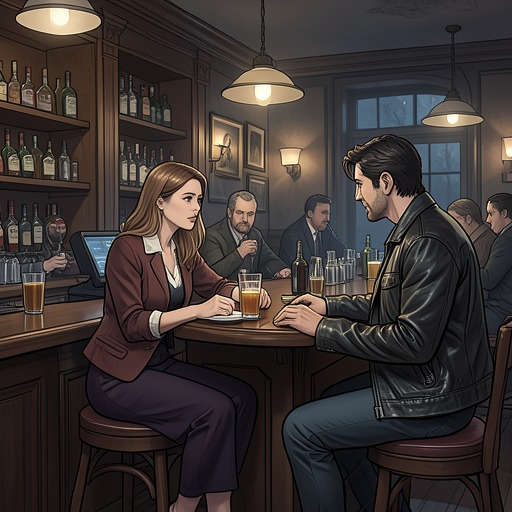
The final tavern scene displays Brigitta and Kingsley as partners in both affection and business. While the others gather, Kingsley leans over the bar to kiss Brigitta aggressively, and she reaches across to hold him in place. Their intimacy is comic, energetic, and unmistakably mutual. It also restores the tavern as a living household rather than a backdrop for Sylvaine’s story. Brigitta’s relationship with Kingsley supplies the domestic continuity that Sylvaine has depended upon from the beginning.
Legacy and Narrative Significance
Sylvaine eventually returns with enough money to repay part of what Brigitta and Kingsley have done. She has already paid the tavern’s food and drink suppliers and commissions carpenters and builders to expand the premises according to Kingsley’s wishes. She calls this only the first part of reciprocating their care and explains that she now has a way to ensure that neither of them will want for anything. The gesture converts survival into reciprocity: Brigitta’s earlier generosity helped sustain Sylvaine until she could acquire the resources to sustain them in turn.
Yet Sylvaine also insists that she owes them nothing beyond letters and occasional visits. The statement rejects the idea that kindness must be repaid before it can be accepted. Her financial gift is gratitude and responsibility, not the settlement of a debt that would make their relationship transactional. By promising that The Rusty Nail will be her favored stopping place as a world-famous bard, she preserves the tavern as part of her future rather than treating it as an embarrassing remnant of poverty.
Brigitta’s narrative significance rests in this transformation of ordinary labor into lasting belonging. She is an elf-friendly presence in a society shaped by anti-elf suspicion, a provider whose work protects a hungry performer, and a member of the couple who first recognizes Sylvaine as someone worth making room for. Her care does not demand that Sylvaine stay small or remain dependent. Instead, it gives Sylvaine food for the road, a scented reminder of domestic life, clothing marked by affection, and a place to return when fame no longer answers the question of where home is.